HACCP: A Management Responsibility?
In 2006, EU Regulation EC No 852/2004 made HACCP a legal requirement for food operators to implement its principles. Known as Hazard Analysis and Critical Control Points, HACCP is crucial for food safety management due to its importance and legal implications of lacking robust systems. Is HACCP a management responsibility? Since 1996, I’ve trained many across Levels 2, 3, and 4. Despite its importance, many in the food industry don’t fully understand HACCP, its terminology, principles, and roles. A common misconception is that HACCP is mainly about health and safety, but it primarily focuses on food safety by assessing microbiological, physical-chemical, and allergenic hazards.
HACCP, developed in the 1950s by NASA to protect astronauts’ food, shifted from end-product testing to a proactive prevention system. It became a voluntary standard in the early 1990s and later a legal requirement in national food safety laws.
The principles of HACCP are still misunderstood after all these years. Although food safety management systems have developed, food preparation was not broken down to identify which controls in the food production process were not essential, because later controls were in place to address potential problems with the product.
Although the regulation became a legal requirement in January 2006, it was published in 2004, giving the industry two years to implement a system by that date. The regulation became mandatory under the EU Hygiene of Foodstuffs regulations.
Is HACCP a management responsibility?
”“food business operators shall put in place, implement and maintain a permanent procedure based on the HACCP principles”.
Regulation (EC)no 852/2004 0n the hygiene of food stuffs.
The Implementation of HACCP is a management Responsibility.
Although HACCP is mandated by law, senior management must allocate the necessary resources for its implementation and management. Food product safety is primarily the responsibility of management. As we know, food products produced in manufacturing must be ‘fit for human consumption’. For HACCP to be effective, it should be integrated into the entire production process and made accessible to everyone.
What is the Terminology Used in a HACCP Plan?
Understanding HACCP jargon is key to working effectively with the plan, a vital part of the Food Safety Management System (FSMS). The FSMS helps identify, assess, and control hazards affecting food safety, including policies like GMP and GHP, along with controls and documentation to ensure safe, uncontaminated food that meets legal standards. These prerequisite programmes (PRPs) form a foundation for HACCP, making its development easier since they manage routine hazards daily. The HACCP plan—written or electronic—follows seven principles to control risks during food production.
“Hazard: Anything which may cause harm to your customers through eating the food you produce” Codex 2020.
Food safety risk is the likelihood of hazards in food. Risk assessment identifies hazards and evaluates their likelihood, severity, and significance. Critical Control Points are where hazards matter. HACCP has eleven steps, including seven principles. Prerequisite Programmes such as GHP, GMP, training, and traceability are foundational. HACCP aims to produce safe food and minimise harm but does not address health and safety concerns.
Assembly of a HACCP Team.
A HACCP team is formed to ensure proper implementation of the ‘HACCP plan’, usually made up of experienced, trained members. The team develops and implements a system to control biological, chemical, physical, or allergenic hazards that could harm consumers. The team size varies with the manufacturing process; in smaller organizations, members may have dual roles. Members should know about production, hazards, risk control, monitoring, corrective actions, and process technology. The leader managing HACCP should understand HACCP and the process. Typically, members include a quality assurance officer, engineer, production specialist, packaging/distribution manager, and a scribe for notes.
Training the HACCP Team
For the HACCP plan to be effective, the team and those closely involved with the application should receive training.
As they drive the HACCP plan, the team should complete at least level 3, with the team leader possibly completing
level 4.
Those on the periphery should receive at least level 2 HACCP training.
Expert Training
I have delivered HACCP training across various food sectors for many years. The Level 2 Award in HACCP for Catering, Levels 2 and 3 for Manufacturing, Level 3 for Catering, and Level 4 for Manufacturing and Catering, based on Codex Principles. All courses are developed and delivered by Philip Wadsworth of Industry Insights on the customer’s own site. Certificates are crafted to meet the employer’s requirements by Philip Wadsworth. Contact me on my mobile 07764789450 for more info.
Describe the Products and Processes?
Products must be described with the recipes, ingredients, and sources of the raw materials. Include any potential hazards and risks associated with them. Specify the intended storage, such as refrigeration or freezing, and detailed processing methods, such as cooking or smoking. Clarify how the products will be distributed. Detail the shelf life, including best-before or use-by dates and their formats. Describe the packaging, such as vacuum packaging or food-safe film. The labelling instructions should list ingredients by percentage, with the highest listed first, and allergens in bold. Finally, outline the storage process for the finished product, indicating how long it must be refrigerated after production.
Identify the End Users
The likely consumer should be considered. All groups of end users will have vulnerable groups, such as babies and older people.
The end user’s abuse must be considered, such as leaving the product in the car on a hot day or driving a long distance. The possibility of reheating the product and eating it hot must also be considered. Will it then be reheated again?
Construct a Process Flow Diagram
The HACCP team initially sketches the diagram, which can omit critical manufacturing steps, leading to their exclusion from risk assessment. It follows the production sequence, with each member ensuring accuracy and detailing steps from raw material arrival to packaging, including reworked products and external packaging. Key details like storage times, cooking, blast-chilling durations, and temperatures should be recorded. The team should verify the diagram by walking through it to spot missed steps and update as needed. Repeated walkthroughs, especially during night shifts, help ensure accuracy across all shifts, maximising the diagram’s and HACCP plan’s effectiveness.
The 7 Principles of HACCP
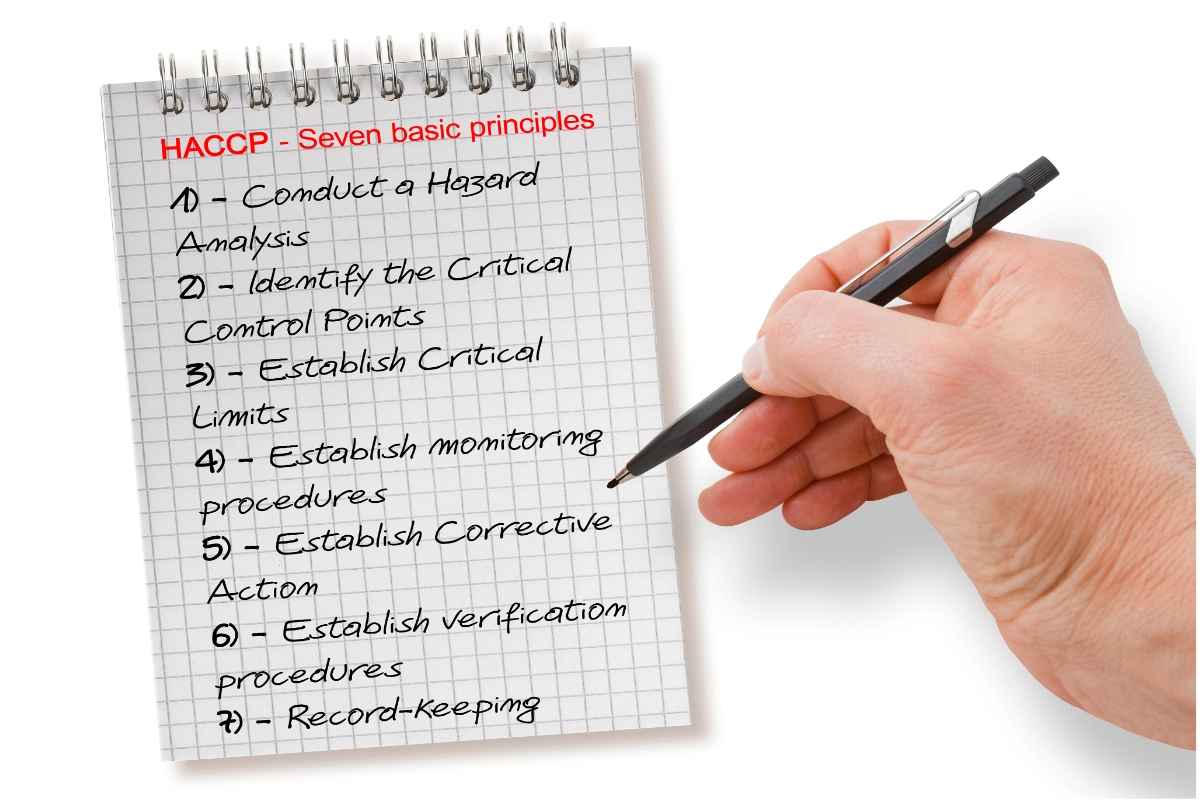
HACCP is a set of seven principles that provide a framework for conducting a risk assessment and identifying critical control points (CCPs) where controlling a hazard is essential. These CCPs can then be monitored to minimise risk and enable immediate action if a hazard arises. When implementing HACCP, there are seven principles to follow to make the system effective and efficient.
Conduct a Hazard Analysis (Principle 1)
The first step in HACCP is to identify food safety hazards during processing, starting with selecting raw materials and ensuring safety standards. This includes observing the process flow and activities around the main line, like wearing blue gloves and beard snoods. Knowledge and judgment help anticipate potential issues. HACCP addresses physical, biological, and chemical hazards, mainly focusing on biological hazards such as foodborne illnesses, cleaning products, and physical contaminants.
Determine the Critical Control Points (CCPs) (Principle 2)
The critical control points (CCPs) are the steps in the process where
‘Control measures are essential to eliminate or reduce the hazard to an acceptable level.
Failure to apply control measures effectively may harm or injure the end consumer. A ‘decision tree’ is used to determine each CCP, drawing on the HACCP team’s expertise. It’s a diagram of questions to assess if a step is a control or critical control point—relying on the team’s knowledge. For example, meat preparation is a control point. When meat is cooked, the decision tree identifies it as a CCP, also determining if it’s cooked and for how long. Training and supervision are recommended at each CCP, such as during shifts. It’s good practice to record each CCP’s justification. This helps produce justified CCPs for monitoring, corrective actions, and verification procedures within the FSMS.
Establish Validated Critical Limits for Each CCP (principle 3)
When establishing CCPS, the HACCP team must set validated critical limits for each CCP that are measurable and aligned with control measures such as temperature, time, and physical parameters. Bacteriological sampling is avoided because of delayed results. A tolerance around the limit helps detect breaches early. For example, high-risk food stored at 8 °C for 4 hours must be destroyed if the limit is exceeded, or corrected proactively. Monitoring ensures the process remains under control and involves observation or measurement, such as temperature, with quick results. If deviations occur, causes are addressed. Corrective actions involve dealing with affected products and restoring control, with procedures specifying actions, responsible persons, and reporting. When a limit is breached, products may be quarantined, tested, reprocessed, or destroyed if unsafe. Supervisors and management review breaches, prevent recurrence, and decide on product release or recall, ensuring labels are clear for traceability. Recalls are costly and can lead to compensation demands.
Validate the HACCP Plan and Establish Verification Procedures (Principle 6)
The key principle is to verify that the HACCP plan effectively controls hazards, often through a trial validation period validating CCPS and PRPs. For example, maintaining a minimum temperature of 75 degrees during meat cooking, with timing varying based on the meat type, is essential. Verification involves ensuring personnel follow monitoring procedures and meet food safety standards, with frequency based on monitoring records. This process confirms the plan’s effectiveness and the product’s safety.
Establish Documentation and Record Keeping (Principle 7)
Documentation for HACCP should match the food process’s size and complexity. Complete it timely with signature and date for completeness. Properly completed documentation supports a due-diligence defence in court. Management uses records to investigate complaints, during inspections, or audits. HACCP and prerequisite documents should be stored in hard copy or electronic formats, preferably both. Include in each document the title, developer’s name, version, and date. Completed evidence shows that food safety is properly managed.
Reviewing the HACCP Plan
The HACCP plan should be reviewed regularly, at least annually, and not just stored away in a manual. It must be a living document, regularly updated to reflect new products, process changes, machinery, scientific info, or recipe adjustments from new suppliers. Proper documentation of changes—who made them and when—is essential to ensure correct implementation, prevent contamination, and keep the plan effective.
Summary
Food hazards can pop up during production, but the HACCP system is here to help us cut down risks and keep things safe. It encourages a caring safety culture by getting everyone involved. When used the right way, HACCP not only lowers business risks but also boosts customer trust and makes sure our products are safe. Its proactive approach allows us to fix issues right on the spot during production, saving money on testing, rework, waste, complaints, and recalls. Plus, HACCP helps us follow legal rules, showing we’re doing our best to be responsible. Making sure we implement it properly is key to enjoying these benefits. Luckily, there are handy guides available, like the free food hygiene guide for the Catering Industry, to help us stay compliant.

https://shorturl.fm/PzAr0